
Understanding the Key Differences Between Crypto and Stocks Before Starting Your Investment Journey
The decision to invest in financial markets almost always begins with a question: where should I start? For many modern investors, that question now involves two fundamentally different categories of asset, traditional stocks and cryptocurrencies, each with its own structure, risk profile, and underlying logic.
Understanding those differences before committing capital is not just preparation. It is the foundation on which every subsequent investment decision rests. Choosing between these asset classes without understanding how they differ is equivalent to selecting a route without knowing the terrain.
What You Are Actually Buying?
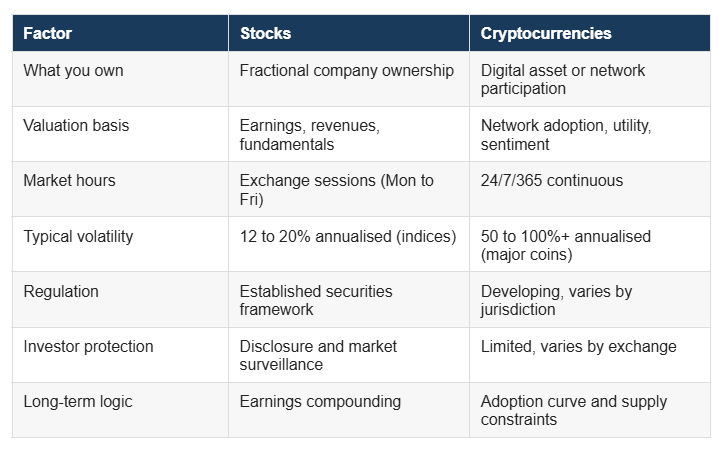
When you buy a share of stock, you are purchasing a fractional ownership interest in a company, a legal claim on a portion of its assets, earnings, and future cash flows. The value of that share is ultimately anchored to the financial performance of the underlying business: revenue growth, profitability, competitive position, and the expectations of future earnings that the market collectively prices in.
When you buy a cryptocurrency, the relationship is different. Some cryptocurrencies, like Bitcoin, function primarily as decentralised stores of value, with no underlying business generating cash flows. Others, like Ethereum, represent ownership of computational resources or participation in decentralised networks that generate utility. Still others represent governance rights, access to services, or speculative positions in projects at various stages of development.
This structural difference matters for how you evaluate each asset. Stock analysis has established frameworks: earnings multiples, revenue growth rates, competitive moats, balance sheet strength. Cryptocurrency valuation involves network activity metrics, adoption curves, protocol development, regulatory environment, and sentiment dynamics that do not map cleanly onto traditional equity analysis.
Ownership, Rights, and Regulation
Stock ownership comes with defined legal rights in most jurisdictions: the right to vote on corporate matters, the right to receive dividends if declared, and the protection of securities regulations that govern disclosure, insider trading, and market manipulation. These frameworks have been developed over decades and provide a layer of investor protection that is built into the structure of equity markets.
Cryptocurrency ownership is legally simpler in structure. Holding a private key gives you control of the asset. However, the regulatory environment is significantly less developed and varies substantially by jurisdiction. Investor protections that equity holders take for granted, such as disclosure requirements, market surveillance, and compensation schemes, are absent or inconsistent across crypto markets. This does not make crypto inherently inferior as an investment, but it means the due diligence burden on the investor is higher.
How Each Market Operates
Stock markets operate within structured trading sessions, specific hours during which exchanges are open, with defined pre-market and after-hours periods. Trading occurs through regulated exchanges with market makers, circuit breakers that halt trading during extreme moves, and clearing systems that guarantee settlement.
Cryptocurrency markets operate continuously, 24 hours a day, seven days a week, 365 days a year, without circuit breakers or centralised clearing guarantees. This continuous operation creates opportunities that equity markets do not offer, including global participation without time constraints, and risks that equity investors do not face. Significant price moves can occur while the investor is asleep, without the pause mechanisms that would halt equity markets.
Volatility and Risk Profiles
The volatility difference between the two asset classes is significant and consistent. Major stock indices, including the S&P 500 and the FTSE 100, have historically experienced annual volatility in the range of 12 to 20 percent. Individual stocks are more volatile, but blue-chip equities rarely move more than a few percent in a single session without a specific catalyst.
Major cryptocurrencies routinely experience double-digit percentage moves within single trading sessions, and smaller cryptocurrencies can move by multiples within days. This volatility reflects several factors: thinner order books relative to equity markets, the absence of fundamental valuation anchors that limit equity drawdowns, and the dominance of retail and momentum-driven participation in price discovery.
Volatility is not inherently bad. It creates the opportunity for significant gains alongside the risk of significant losses. The relevant question for any investor is whether the volatility of a given asset is compatible with their time horizon, their capital allocation, and their capacity to absorb adverse moves without making reactive decisions.
Time Horizons and Investment Logic
Stock investing has a well-established long-term investment logic: companies generate earnings, those earnings grow over time, and patient investors capture that growth. The compounding of returns over years and decades is the mechanism that makes equity investing productive for investors with long time horizons, even through significant short-term drawdowns.
Cryptocurrency investment involves a different time horizon logic. Long-term arguments for crypto focus on adoption curves, the expansion of the user base for decentralised networks, and the supply constraints of assets like Bitcoin. Short-term cryptocurrency trading is driven more by sentiment, momentum, and market cycle dynamics than by fundamental value creation.
Neither logic is wrong, but they require different investor mindsets, different evaluation frameworks, and different responses to adverse market conditions.
Practical Access and Costs
Access to stock markets requires brokerage accounts, which in most jurisdictions involve identity verification, regulatory compliance, and account structures that vary by market. Trading costs vary, including commissions, spreads, and in some cases stamp duty or financial transaction taxes.
Cryptocurrency access is available through centralised exchanges with similar verification requirements, decentralised exchanges with wallet-based access, or through CFD brokers that provide exposure to crypto price movements without requiring custody of the underlying asset. Each access route has different cost structures, custody risks, and regulatory implications.
How QuoMarkets Provides Access to Both Asset Classes
QuoMarkets provides access to both cryptocurrency and stock CFDs within a single multi-asset trading environment, allowing investors to build exposure across both asset classes through a consistent platform structure. CFD access to these markets means traders can participate in price movements in both directions without the custody requirements of holding underlying assets, with the spreads, leverage parameters, and risk management tools clearly disclosed.
For investors at the beginning of their investment journey who want to understand both asset classes in practice, access to both through a single account provides the comparative exposure that accelerates that understanding.
Frequently Asked Questions
Is crypto or stocks a better investment?
Neither is universally better. They serve different purposes in a portfolio. Stocks offer exposure to business value creation with established legal frameworks. Crypto offers exposure to digital asset adoption with higher volatility and potential returns. The appropriate allocation depends on risk tolerance, time horizon, and investment goals.
Can I invest in both crypto and stocks?
Yes. Many investors hold both. The combination can provide diversification across different risk drivers, though the correlation between crypto and equities has increased during certain market cycles. Understanding how each behaves in different market conditions is important before allocating to both.
Is crypto more risky than stocks?
In terms of price volatility, yes. Major cryptocurrencies are significantly more volatile than major stock indices. This creates both higher return potential and higher loss potential. The regulatory and custody risks of crypto are also different from the risks of equity investing.
Do I need different accounts for crypto and stocks?
This depends on the access route you choose. CFD brokers like QuoMarkets provide access to both through a single account. Direct investment in stocks requires a brokerage account and direct holding of cryptocurrencies requires an exchange account and optionally a self-custody wallet.