
Prop Trading vs Retail Broker Trading: Structural Differences Every Trader Should Understand
The growth of funded trading programs has made proprietary trading genuinely accessible to retail participants in a way that did not exist a decade ago. Where institutional prop trading was once the domain of professional desks at banks and hedge funds, a substantial market has developed around individual traders accessing firm capital through structured evaluation programs.
At the same time, retail broker-based trading trading your own capital through a licensed broker with access to multiple asset classes remains the predominant model for individual market participants globally.
These two models are genuinely different: in their structure, their requirements, and what they offer the trader. Neither is universally superior. The right choice depends on what a trader values, how they manage risk, and what their capital situation looks like. This article examines the structural differences clearly so that judgment can be made on accurate terms.
Capital: Who Owns It and What That Means
In prop trading, the capital belongs to the firm. The trader accesses it through an evaluation process and retains a share of profits typically 70 to 90 percent but has no ownership claim on the underlying capital. If the account reaches the maximum drawdown threshold, the funding arrangement ends and capital access ceases, regardless of the trader's prior performance.
In retail broker trading, the capital belongs to the trader. Deposits are made from personal funds; the trader retains full ownership of the account balance. Losses reduce personal capital; gains are entirely the trader's to keep or reinvest. There is no profit sharing, no firm-enforced drawdown limit, and no evaluation to pass.
This single difference shapes almost everything else about each model. Prop trading offers scale access to capital most retail traders could not accumulate independently in exchange for constraint. Retail broker trading offers ownership and control in exchange for the limitation of trading with what you personally have.
Decision-Making and Autonomy
Prop trading operates within a rule framework set by the firm: defined trading windows, instrument restrictions, drawdown thresholds, news trading rules, and in some cases strategy-type limitations. These rules protect firm capital and ensure consistent risk behaviour across the funded book. Breaching them results in evaluation failure or account termination regardless of financial performance.
Retail broker trading involves no equivalent external constraints. The trader controls position sizing, strategy selection, risk parameters, and account management entirely without evaluation requirements, performance targets within defined timeframes, or rules governing which strategies are permissible.
The tradeoff is worth stating plainly: prop trading offers more capital with less autonomy; retail broker trading offers full autonomy with less capital. Which side of that tradeoff matters more depends entirely on the individual trader's priorities and approach.
Traders with systematic approaches that work within standard risk parameters often operate effectively in prop environments. Traders who rely on flexible risk management, unconventional strategies, or frequent parameter adjustment typically find retail broker models more accommodating.
Evaluation and Access Requirements
The evaluation phase of prop trading is one of its defining structural features. To access firm capital, traders must typically complete a challenge — a defined period during which they must reach a profit target without breaching drawdown or rule constraints. These evaluations require a fee, range from 30 to 90 days, and carry specific performance parameters that must be met simultaneously.
Retail broker trading has no equivalent barrier. Opening an account, funding it, and beginning to trade can be completed within hours. The only capital requirement is the broker's minimum deposit in many cases a low threshold designed to be accessible.
This reflects the different risk profiles of the two models. A prop firm bears direct financial risk if a funded trader loses capital , the evaluation manages that risk. A retail broker bears no direct exposure to the trader's losses, which is why access requirements are minimal.
Strategy Flexibility
Prop evaluation parameters are built around specific risk profiles: consistent daily returns, limited drawdown, rule-compliant execution. Strategies suited to these constraints disciplined intraday approaches, systematic trend following with tight stops, well-defined entry and exit criteria work well in prop environments.
Strategies involving larger individual position drawdowns, holding through significant adverse moves, or generating returns through occasional large wins rather than consistent smaller ones are often poorly suited to standard evaluation parameters even if they are profitable over longer horizons with appropriate capital.
Retail broker trading imposes no equivalent constraints. Swing trading, position trading, multi-day holds, high-volatility approaches, and long-duration strategies are all equally available. The trader defines their own risk-reward parameters and adjusts them freely.
Technology: Institutional Monitoring vs Trader-Focused Platforms
Prop firms invest in institutional-grade risk monitoring systems tracking every funded account's exposure, drawdown, and rule compliance across the entire book in real time. This benefits the firm primarily, though traders gain access to execution infrastructure they could not replicate independently.
Retail broker platforms are oriented around the individual trader's needs: charting, order types, economic calendars, and analysis tools that support individual decision-making. MT4 and MT5 the industry standard provide a full professional toolset accessible through most retail brokers without institutional infrastructure requirements.
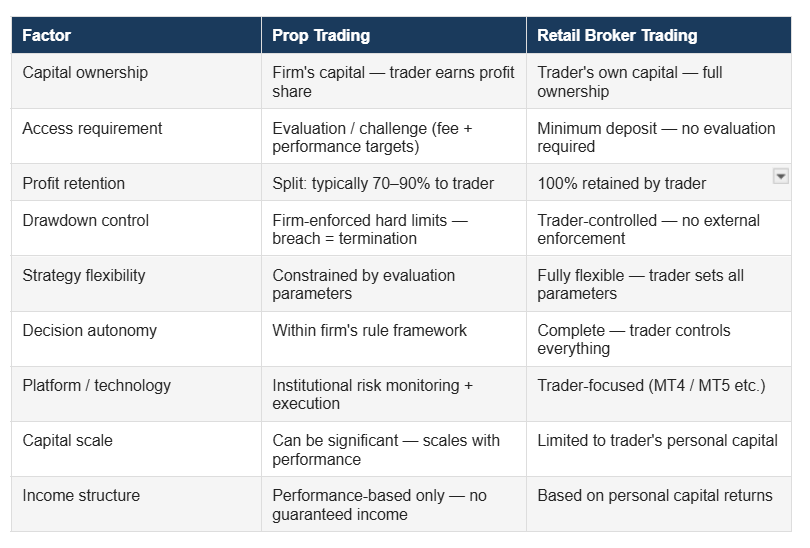
Side by Side Comparison
Which Model Suits Which Trader
Prop trading suits traders who have a defined, systematic approach that fits within standard risk parameters; who are comfortable with performance-based income variability; and who want access to capital significantly larger than they could fund independently.
Retail broker trading suits traders who want full ownership of their capital; who use strategies requiring flexible risk management; who are building at their own pace without evaluation timelines; and who prioritise autonomy and strategic flexibility over capital scale.
For traders operating in the retail model, the quality of the platform and trading environment makes a meaningful practical difference. TradeQuo provides access to forex, indices, commodities, stocks, and cryptocurrency markets through MT4 and MT5 with a no-markup pricing model and transparent cost structures that support active traders who want to understand exactly what they pay per trade. The platform's low minimum deposit and multi-language support make it accessible to traders across Southeast Asia, MENA, Africa, and Latin America.
Conclusion
Prop trading and retail broker trading are not competing versions of the same model they are different structures with different requirements and different tradeoffs. The most useful question is not which is better in the abstract, but which is better suited to a specific trader's approach, risk tolerance, and goals.
Making that assessment on accurate terms with a clear understanding of what each model actually requires is the starting point for participating effectively in either.