
Trading Hours and Liquidity Differences Between Crypto Markets and Traditional Stock Exchanges

One of the most consequential structural differences between cryptocurrency markets and traditional stock exchanges is when and how they operate. For traders accustomed to one environment, moving to the other requires a genuine adjustment, not just in schedule, but in the strategies and risk management approaches that different trading structures demand.
Understanding these differences in depth, not just knowing that crypto trades around the clock and stocks do not, shapes how you plan entries, manage open positions, and think about the risks that arise when markets behave differently depending on the time of day.
How Stock Exchange Sessions Work
Traditional stock exchanges operate within defined trading sessions. The New York Stock Exchange and NASDAQ open at 9:30 AM Eastern and close at 4:00 PM Eastern, Monday through Friday, with additional pre-market and after-hours trading available through electronic venues. The London Stock Exchange operates from 8:00 AM to 4:30 PM GMT. Tokyo, Frankfurt, and Sydney each operate within their own session windows, creating a sequence of overlapping and non-overlapping activity across global time zones.
These sessions create predictable liquidity patterns within each trading day. The first 30 to 60 minutes after a major exchange opens, particularly New York, are typically the most active, as overnight developments are priced in and institutional order flow enters the market. Liquidity thins in the middle of the session, picks up again in the final hour as positions are adjusted ahead of the close.
The daily close is also a structural reset. Positions held overnight are subject to gap risk, the possibility that news between the close and the next open causes prices to open materially different from where they closed. This gap risk is managed by professional traders through overnight position sizing, hedging strategies, and deliberate decisions about when to hold and when to be flat.
How Crypto Markets Operate
Cryptocurrency markets have no equivalent structure. They operate continuously, 24 hours a day, seven days a week, 365 days a year, without exchange sessions, daily closes, or circuit breakers that halt trading during extreme moves. This continuous operation creates opportunities that equity traders do not have: the ability to react to news events at any hour, global participation without time zone constraints, and the absence of gap risk from overnight closes.
It also creates risks that equity traders do not face. Significant price moves can develop and complete while a trader is asleep, away from screens, or otherwise unable to monitor positions. There is no structural pause that limits how far a market can move in a single continuous period. Circuit breakers that equity markets use to interrupt panic-driven cascades do not exist in crypto markets.
The continuous nature of crypto markets also means that weekends, when most equity traders are not active, can produce significant price movements without the institutional participation that typically provides some degree of market stabilisation during regular equity sessions.
Liquidity Distribution Across the Day in Crypto
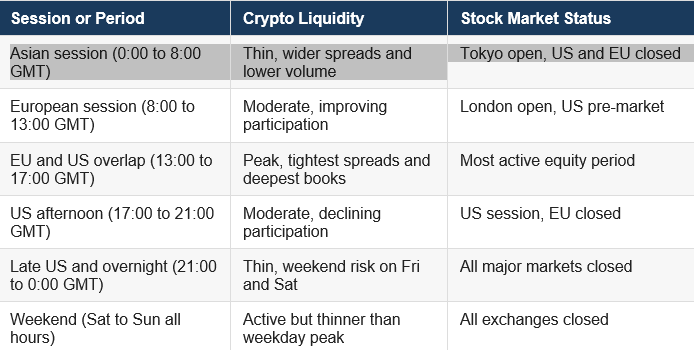
Despite the 24/7 availability of crypto markets, liquidity is not uniformly distributed across the day. Participation peaks during the overlap of European and US trading hours, roughly 1:00 PM to 5:00 PM GMT, when the largest concentrations of institutional and professional participants are active. During Asian session hours and particularly in the early morning GMT window, crypto liquidity thins substantially.
This uneven distribution has practical consequences. Trading during thin liquidity periods produces wider bid-ask spreads, greater slippage on market orders, and sharper price reactions to moderate-sized trades, all of which increase the real cost of execution beyond the stated spread. Large price moves during Asian hours, when order books are shallower, can be more extreme than similar-sized moves during peak European and US participation.
Strategy Implications of Continuous vs Session-Based Markets
Position management: in equity markets, the daily close provides a natural position review point. Many traders either flatten positions before close or consciously accept overnight exposure. In crypto, no equivalent trigger exists, which means position review requires deliberate scheduling rather than market-imposed structure.
Stop-loss placement: weekend crypto trading presents specific risk. Liquidity is thinner, which amplifies stop-loss gap risk. Positions held into a weekend in crypto markets, particularly smaller tokens, are exposed to moves that may not be recoverable by Monday.
News reaction timing: a central bank announcement at 2:00 PM EST affects equity markets within their operating hours with full liquidity. The same announcement affects crypto markets at the same time but within a market that never closed. Continuous position holders have had the entire overnight period to react, potentially creating pre-announcement moves not visible to equity-focused traders.
Overnight gap avoidance: equity traders who want to avoid overnight gap risk close positions before market close. Crypto traders have no equivalent. Price alerts and stop-loss orders serve as partial substitutes for the natural position review that the equity close provides.
The absence of a daily close in crypto is both its structural advantage, the ability to act on news at any hour, and its most significant risk management challenge. Strategies designed for session-based markets need genuine adaptation before being applied to continuous markets.
How TradeQuo Supports Both Session and Continuous Market Trading
TradeQuo provides access to both cryptocurrency and stock CFDs, with the MT4 and MT5 platform tools that support the position monitoring, alert-setting, and stop-loss management that continuous market trading requires. For traders moving between equity sessions and crypto markets, a single account structure simplifies the operational management of exposure across different market structures.
Frequently Asked Questions
What are the best hours to trade crypto?
Crypto liquidity is deepest during the European and US session overlap, roughly 1:00 PM to 5:00 PM GMT, when institutional participation is highest and spreads are tightest. Execution during Asian session hours or weekends involves thinner liquidity and potentially higher slippage, particularly for larger orders or less liquid tokens.
Is weekend crypto trading more risky?
Weekend crypto trading involves thinner liquidity and reduced institutional participation, which can amplify price moves in both directions. Significant news events occurring over weekends can produce sharp moves in thin markets that would have been absorbed more gradually during weekday peak liquidity. Holding large crypto positions into weekends warrants additional risk awareness.
Do stock market events affect crypto trading hours?
Not directly. Crypto markets do not close around equity sessions. However, major equity market events such as central bank decisions and significant economic releases also affect crypto markets simultaneously, since many participants trade across both. The reaction in crypto may be amplified by the thinner order books relative to equity markets.
Can I hold a stock position overnight the same way I hold crypto?
Both allow overnight holding, but the structure is different. Stock positions face gap risk from the close to the next open, as prices can jump or fall sharply based on after-hours developments. Crypto positions face continuous market risk with no structural gap, but also no natural review point that the daily close provides equity traders.
Disclaimer: This article is for informational and educational purposes only and does not constitute financial or investment advice. CFD and forex trading involves significant risk, including the possible loss of principal. 72.6% of retail investor accounts lose money when trading CFDs with this provider. Always conduct independent research and consult a qualified financial adviser before making any trading or investment decisions.